
I stood waiting, soaking in time. I tried to imagine person in a place and circumstance for whom freedom was simply to be unoccupied, idle. And all of a sudden, boredom became the wildest luxury - unimaginable. How is it that we have become so disengaged from living that life itself, the very air in our lungs, escapes us and creates in us such vacancy?
26 October 2016
20 October 2016
There has to be
"Like all feelings felt for oneself, Mrs. Ramsay thought, it made one sad. It was so inadequate, what one could give in return; and what Rose felt was quite out of proportion to anything she really was."
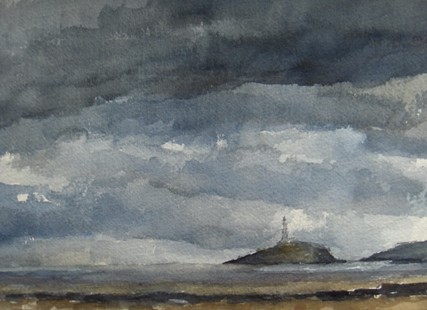
- Virginia Woolf, To The Lighthouse
Somewhere there is a world full of forgotten and unrealised selves, full of children and dreamers and artists; a world full of the life we have lost here on earth.
14 October 2016
On space and freedom pt.1
It's been over a month since the last post but within that gap I'm back in London, settled in a new place and we're now nearly three weeks into school. And it's now past that time in the night beyond which one can't hope to accomplish anything very useful.
This post has been too long in the making - it's still a work-in-progress but there is nothing more restless than a thought left incomplete.
What comes to mind when you think about freedom?
This post has been too long in the making - it's still a work-in-progress but there is nothing more restless than a thought left incomplete.
***
What comes to mind when you think about freedom?
I think
of space. Boundless space.
Unadulterated space. And in the middle of that vast expanse a little girl spins
wildly, recklessly yet - with arms outstretched - she appears poised in an
effortless balance. She staggers about as she turns, but never stumbles;
creating incongruent circles in her course. There is space, there will
always be enough space, she
thinks to herself - not once does she worry about spinning off the edge,
there are no such bounds. And in each and every moment before she halts - pure elation.
But we
live in a world of edges.
On the
plane of our existence, there are edges on all sides. There is never enough
space. Spin too fast, or with too much vigour, and you find yourself on an
edge. The very act distorts your spatial perception, disrupts your sense of
balance - an impractical pastime, too dangerous to be undertaken perched upon
such a precarious precipice.
Often
we spin anyway, tasting the air with our skin; our limbs swing loosely,
collapsing softly against the wind. And we feel absolutely, utterly free. But
then - an edge. And all of a sudden, gravity seizes us and we are captive,
bound, at its mercy. The mirage dissolves into the desert sand, the thirst
returns. It was an illusory freedom after all.
Toward
the close of the novel Nausea by Jean-Paul Sartre, the narrator Antoine, along his spiral into existential angst, sputters:
Is this what freedom is?... I am free: I haven’t a single reason for living left, all the ones I have tried have given way and I can’t imagine any more… I am alone in this white street lined with gardens. Alone and free. But this freedom is rather like death.
What is freedom, really?
Etymologically,
Old English frēo (adjective), frēon (verb), of Germanic origin; related to Dutch vrij and German frei, from an Indo-European root meaning ‘to love’, shared by friend.
Freedom finds
her root in Love; to love is to free.
To love someone is to give him the space to be. To express himself, to act in - and sometimes out - of character. The space to make mistakes. To grow. To explore.

To love someone is to give him the space to be. To express himself, to act in - and sometimes out - of character. The space to make mistakes. To grow. To explore.

To
be loved - truly, wholly, absolutely - then, is to have true, whole and absolute freedom. There is room for joy, and room for error. Breathing space. Allowance. And in all of this, there is a safety - a knowing, deep beyond doubt, that you are loved not for what you are in there here-and-now, but in the always-to-be.
Freedom is not obtained through solitary pursuit, but a relation.
Rilke, in Letters To A Young Poet, implores to his addressee, Kappus:
... believe in a love that is being stored up for you like an inheritance, and have faith that in this love there is a strength and a blessing so large that you can travel as far as you wish without having to step outside it.
An insurance, an assurance. A guarantee.
Freedom is found in this - a portrait of life framed in the knowledge of perfect love. Because perfect love casts out fear.
30 August 2016
On being a self pt. 2
I am much too alone in this world, yet not alone2. Identity
enough
to truly consecrate the hour.
- Rainer Maria Rilke
And that story really resonated with me. The thought of how very lonely it is to be a self, in a world of seven billion other selves. An infinite deck of cards thrown up into the air, tossed by the wind - and descending, each one on its own course. No two the same.
Somewhere deep to our defences, lying dormant, is a longing to be known as we truly are. But what is the "self" in us that needs knowing? Where does "I" end and where does "not I" begin? Pascal muses:
What is the self? A man goes to the window to see the people passing by; if I pass by, can I say he went there to see me? No, for he is not thinking of me in particular. But what about a person who loves someone for the sake of her beauty; does he love her? No, for smallpox, which will destroy beauty without destroying the person, will put an end to his love for her. And if someone loves me for my judgement or my memory, do they love me? me, myself? No, for I could lose these qualities without losing my self. Where then is this self, if it is neither in the body nor the soul? And how can one love the body or the soul except for the sake of such qualities, which are not what makes up the self, since they are perishable? Would we love the substance of a person's soul, in the abstract, whatever qualities might be in it? That is not possible, and it would be wrong. Therefore we never love anyone, but only qualities.
Somehow, we know that who we are goes above and beyond our qualities, i.e. our personality. That you are more than the sum of your affect, behaviour and cognition. More than anything that could ever be phrased in words, envisioned in art, re-enacted through interpretive dance.
That no matter how tightly you embrace someone, you could never engulf a person whole, crawl into his skin, see through his eyes, think with his mind - as much as you understand them, you could never truly understand what it is like to be them. And even if you could, would you still remain you? (A scenario now more plausible than ever before apparently, according to this article.)
Questions. What is identity? How do I identify myself - or rather, what do I identify myself by? What makes me - anyone - matter, in either sense of the word? Do we matter? Should we matter? Are we made to matter? We know so little of what, who we are.

The grey rain-curtain of this world rolls back, and all turns to silver glass, and then you see it.
Even as I have been fully known.
25 August 2016
On being a self pt. I
“It is my growing conviction that my life belongs to others just as much as it belongs to myself and that what is experienced as most unique often proves to be most solidly embedded in the common condition of being human.” - Henri Nouwen
I remember waking up on the morning of my twenty-first birthday with one thought:
I am glad I exist.
It had not occurred to me before, with a tone of such sonority, that it was a wonder to be anything at all, let alone a self - to have a name, face, a place in the world. That each of us is not something, but someone. No matter how small we ever come to feel, we remain irreducibly, relentlessly human.
So what does it mean to be a self? Every notion of the self eventually ends in paradox. A duality. On one hand, distance and isolation; on the other, intimacy and connectedness. The impetus for every relationship arising from the tension between the two.
This train of thought led me to two separate, but not disparate concepts regarding the self which are frequently conflated - Individuality and Identity.
1. Individuality
I have always been fascinated by the psychology underlying individual differences. Temperaments, traits and types; enneagrams, assessments, inventories.
Personality tests appear to operate on a principle akin to that of the classification of music across genres. Pop. Punk rock. Electronic. Blues. Sure, the divisions may be arbitrary and often misplaced - but not reductive in the least. Rather, they capture in their stride the diversity of different styles, laying them out across a spectrum, visible and plain.
I think it's the same way with people - while our present knowledge of human personality is far from exhaustive, "categorising" people can often provide a framework through which we can appreciate the nuances of human behaviour and tendencies. Instead of diminishing individuality, it deepens it. Even the beauty in Art stems from a representation of chaos, organised into a form in which it can be presented, studied and perhaps even understood.

But is introspection a well? Do our attempts to know ourselves help us any further along our road towards a purposeful, well-lived life? Henri Nouwen writes:
Self-affirmation and self-emptying are not opposites because no man can give away what he does not have. No one can give himself in love when he is not aware of himself. Nobody can come to intimacy without having found his identity.
In searching inwardly, we narrow our gaze. One must do so in probing depths. But the limits of self-awareness lie in the strange metaphysical notion that who we are - who we really are - has nothing very much to do with us at all.
As the first line of Rick Warren's The Purpose-Driven Life reads: It's not about you. And if that is true, we have to look much further, higher, beyond ourselves for answers.
Subscribe to:
Posts (Atom)